
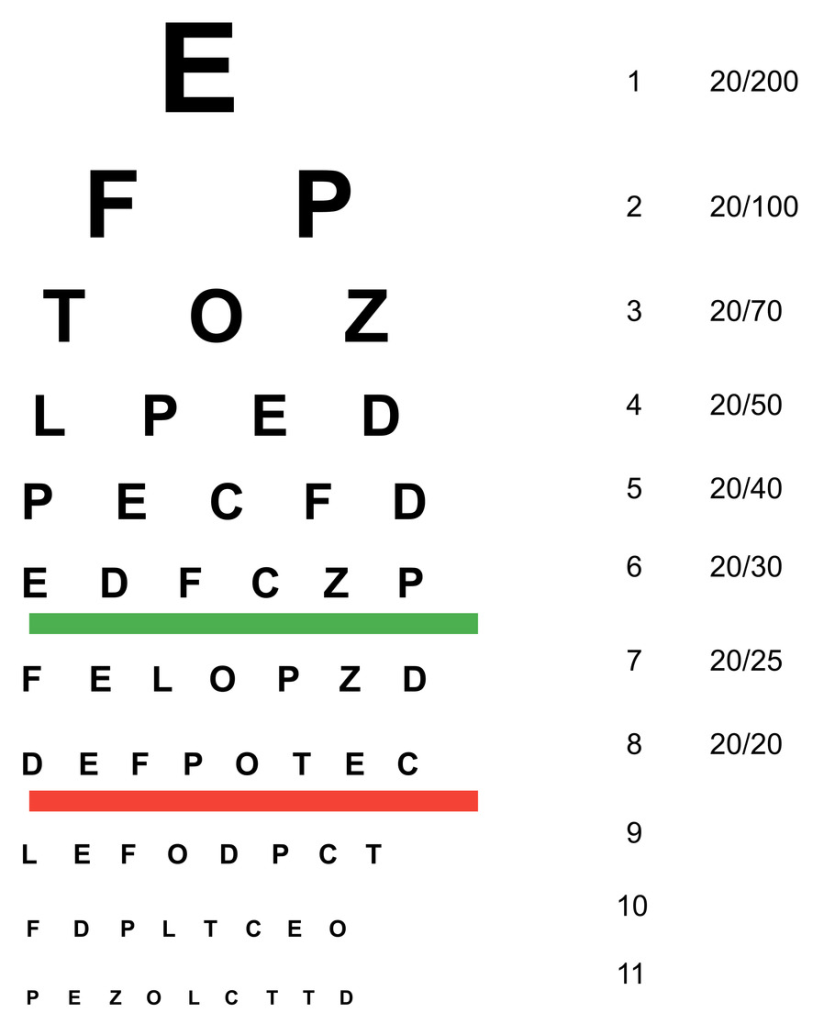
The Snellen Chart is a simple and widely used eye testing tool designed to measure visual acuity (how clearly a person can see).
It consists of rows of letters (or symbols) arranged from large at the top to progressively smaller sizes at the bottom. The most common format uses the letter “E” or standard alphabet letters.
During the test, the patient stands at a fixed distance (usually 6 meters or 20 feet) and reads the letters aloud, starting from the top.
Uses
1. Testing Visual Acuity
• Measures how well a person can see at a distance
• Results are recorded as a fraction (e.g., 6/6 or 20/20 vision)
2. Detecting Vision Problems
• Helps identify conditions like short-sightedness (myopia) and long-sightedness (hyperopia)
3. Eye Screening in Schools
• Commonly used for mass screening of pupils
• Helps detect vision issues early in children
4. Routine Eye Examinations
• Used in hospitals and clinics as a basic eye test
5. Monitoring Vision Changes
• Tracks improvement or deterioration of vision over time
Advantages
- Simple and easy to use
- Affordable and widely available
- Does not require electricity
- Suitable for both adults and children
The Snellen Chart remains one of the most effective and accessible tools for testing eyesight. Its simplicity makes it ideal for clinics, schools, and community outreach programs, helping in the early detection and prevention of vision problems.


Leave a Reply