

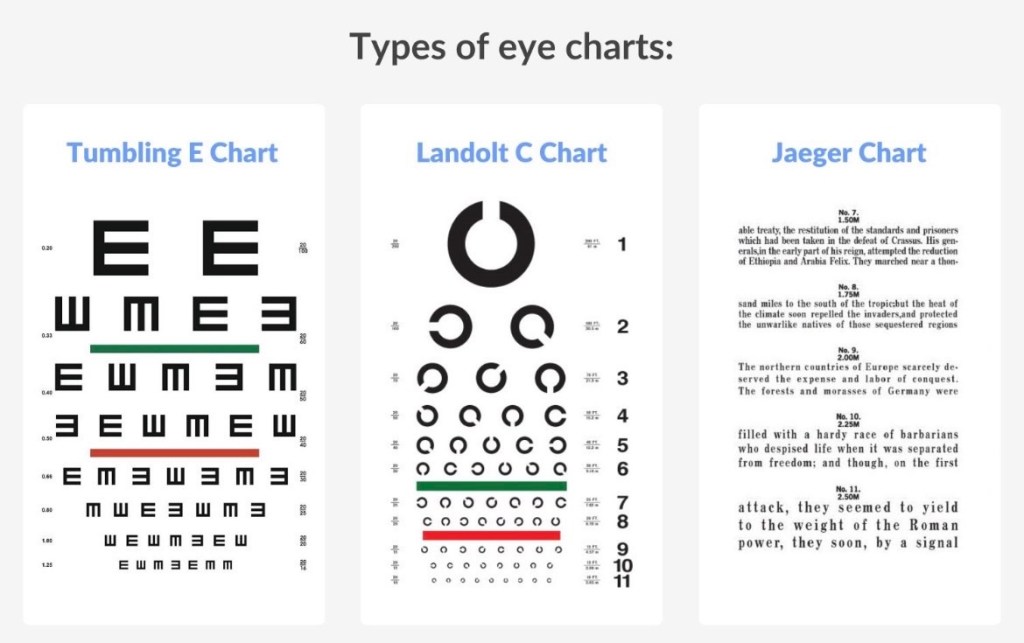
A Jaeger chart is a small eye chart used to test near vision, that is, how clearly a person can see objects up close. Unlike the distance chart used across the room, this chart is held at a reading distance (usually about 35-40cm).
The chart contains paragraphs of text printed in different sizes, labeled as J1, J2, J3, J4, and so on:
• J1 represents the smallest print (best near vision)
• Larger numbers (like J10 or J16) indicate bigger text and poorer near vision
Each eye is tested separately, and the patient is asked to read the smallest text they can see clearly.
Uses
1. Testing Near Vision
The Jaeger chart is mainly used to check how well a person can see things up close, such as reading books or using a phone.
2. Detection of Vision Problems
It helps identify conditions like:
• Presbyopia (difficulty seeing close objects with age)
• Hyperopia (long-sightedness)
3. Prescription of Reading Glasses
Eye care professionals use the results to determine if a person needs reading glasses and the appropriate lens power.
4. Monitoring Eye Health
It is useful in follow-up examinations to track changes in near vision over time.
The Jaeger chart is a simple but important tool for assessing near vision. It helps detect reading difficulties early and ensures proper correction, especially for people experiencing age-related vision changes.
 SafeFuture Foundation for the blind
Leave a comment