

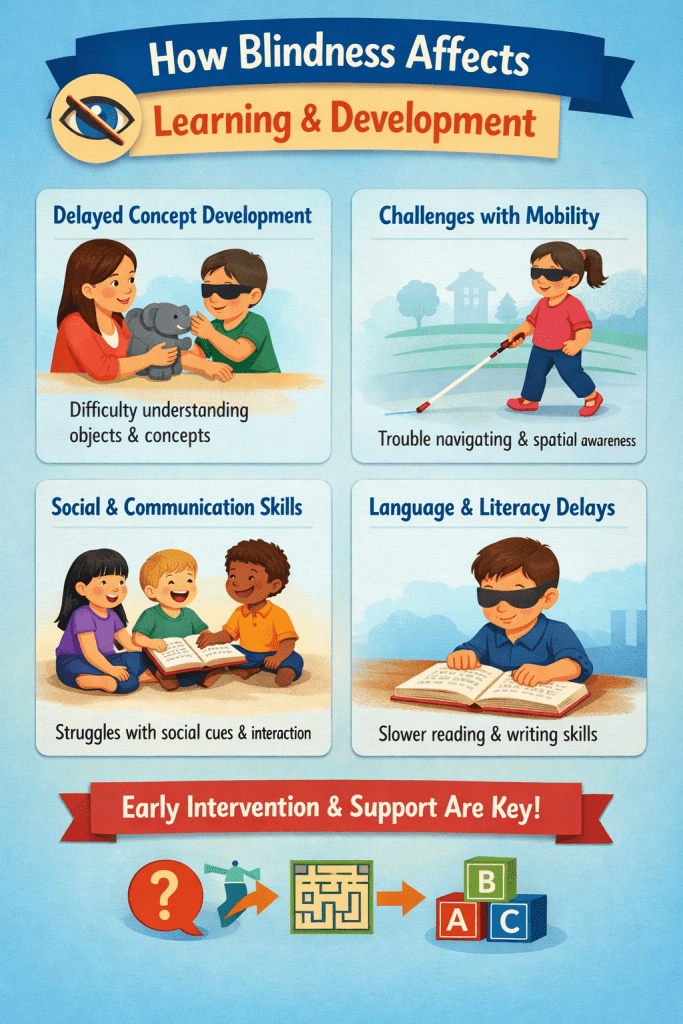
Blindness significantly affects a child’s learning process and overall development, especially when appropriate support systems are not in place. Vision plays a central role in early learning, so its absence requires alternative methods, tools, and teaching strategies to ensure full participation in education and daily life. However, with proper support, children with blindness can learn effectively and achieve their full potential.
Impact on Learning
1. Difficulty in Accessing Learning Materials
Most school materials are designed for sighted learners. Children with blindness may struggle to access:
• Printed textbooks
• Written instructions on the board
• Diagrams, charts, and visual illustrations.
Without adapted materials like Braille, audio books, or screen readers, learning becomes challenging.
2. Slower Reading and Writing Process
Blind learners often use Braille systems or assistive technology, which may take more time to master compared to visual reading. This can affect speed in completing assignments and exams.
3. Limited Visual Learning
Many subjects such as science, geography, and mathematics rely heavily on visual content like diagrams, maps, and graphs. Blind students may find it difficult to understand these concepts without tactile or audio adaptations.
4. Communication Barriers
In some learning environments, lack of awareness about disability can lead to poor communication between teachers and students. This may affect participation in class discussions and group work.
Impact on Development
1. Social Development
Blindness can sometimes lead to social isolation if inclusive activities are not encouraged. Children may miss opportunities to interact freely with peers, affecting confidence and communication skills.
2. Emotional Development
Children with blindness may experience:
• Frustration when learning materials are inaccessible
• Low self-esteem due to dependence on others
• Anxiety in unfamiliar environments
Proper emotional support is essential for healthy development.
3. Physical Development and Mobility
Without orientation and mobility training, children may struggle to:
• Move safely within school environments
• Participate in sports or physical activities
• Develop independence in daily routines
4. Cognitive Development
While blindness does not affect intelligence, lack of proper educational support can limit exposure to experiences that stimulate thinking, problem-solving, and creativity.
Support Systems That Improve Learning and Development
1. Inclusive Education – integrating blind students into regular classrooms
2. Braille Materials and Audio Books
3. Assistive Technology such as screen readers and learning apps
4. Trained Special Education Teachers
5. Peer Support and Sensitization Programs
6. Orientation and Mobility Training
Blindness presents challenges in learning and development, but it does not prevent academic success or personal growth. With inclusive education, assistive technologies, and supportive environments, children with blindness can learn effectively, develop independence, and contribute meaningfully to society.
Creating accessible learning systems is not just an educational need, it is a commitment to equal opportunity for all learners.


Leave a Reply